
Intelligence configuration
Configuration A
- Model
- Illustrative-7
- Version
- 2026.03
- Role
- Technical claim reviewer
- Runtime
- Commercial API
- Compute
- Cloud
Framework
The Model Culture framework is exactly Right Model, Right Version, Right Role, Right Culture, and Right Compute. Customer work sits at the center. The question is which intelligence should do this job, here, for us, not which model family is generally well known.
The correct answer is not simply a model name. It is a configuration: the combination of those five factors under evaluation.
Model Culture Core
Work is the decision context. It is not a sixth canonical pillar. The five factors describe the intelligence configuration around that work.
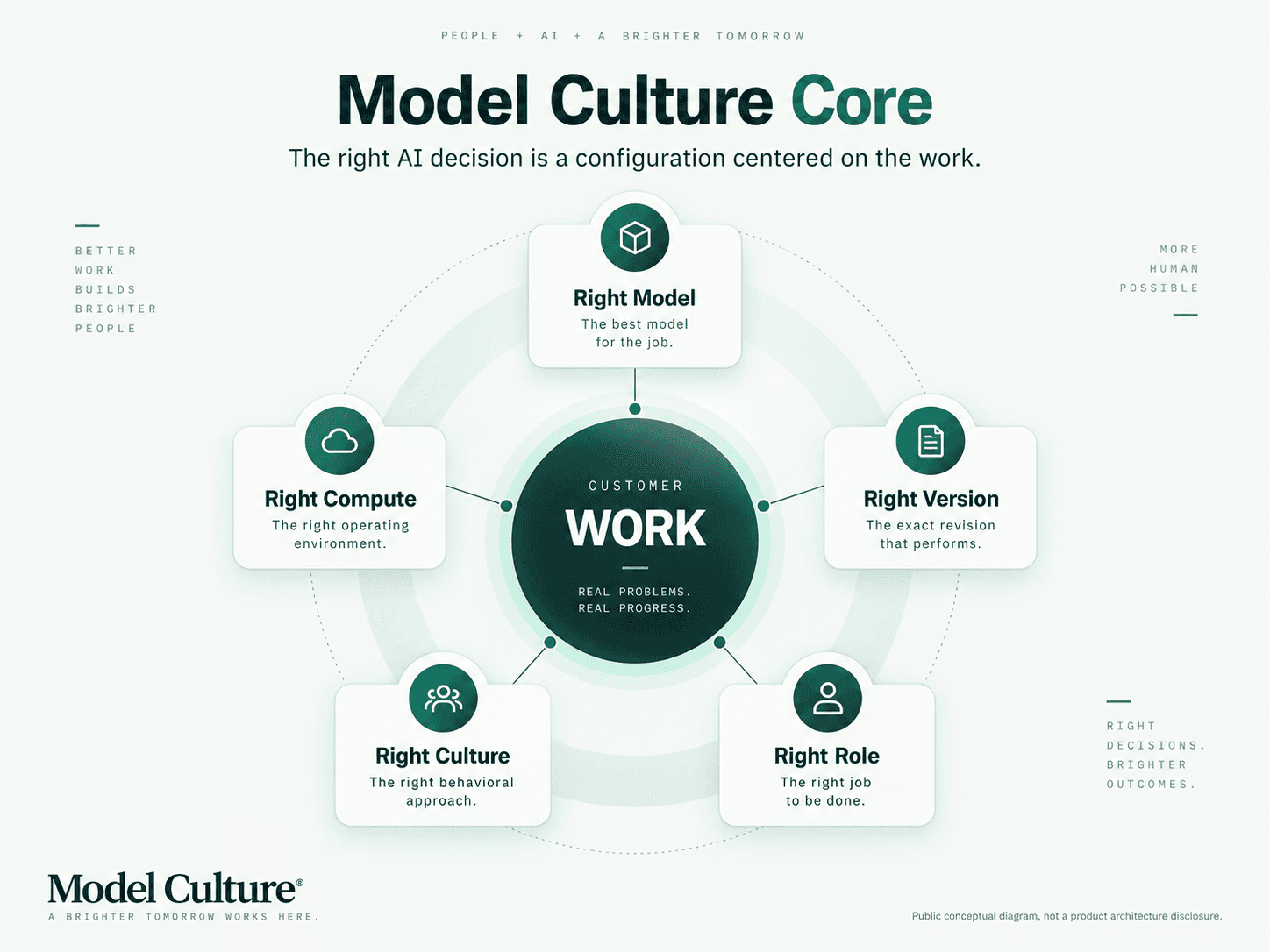
Five factors
Capability is whether a model can do a job. Model Culture is how it behaves while doing the job. The framework is not a generic capability benchmark and it is not a public leaderboard.
Keep the work, the configuration, and the evidence in view together.
Illustrative identity
Exact version matters. Role defines the job. Culture concerns observable behavior while performing that role. Compute includes feasibility, economics, privacy, latency, throughput, and local, cloud, or hybrid considerations.
Intelligence configuration
Intelligence configuration
These identity fields are illustrative. They do not rank named systems. They show why a model family name is not enough.
Workload shape
Workload shape connects requested work to runtime and compute decisions. The job the intelligence is performing, and how it is expected to behave, should inform where and how it runs.
Compute should be chosen in relation to the work, not in isolation. Culture is not only prompting. Compute is not merely hardware.
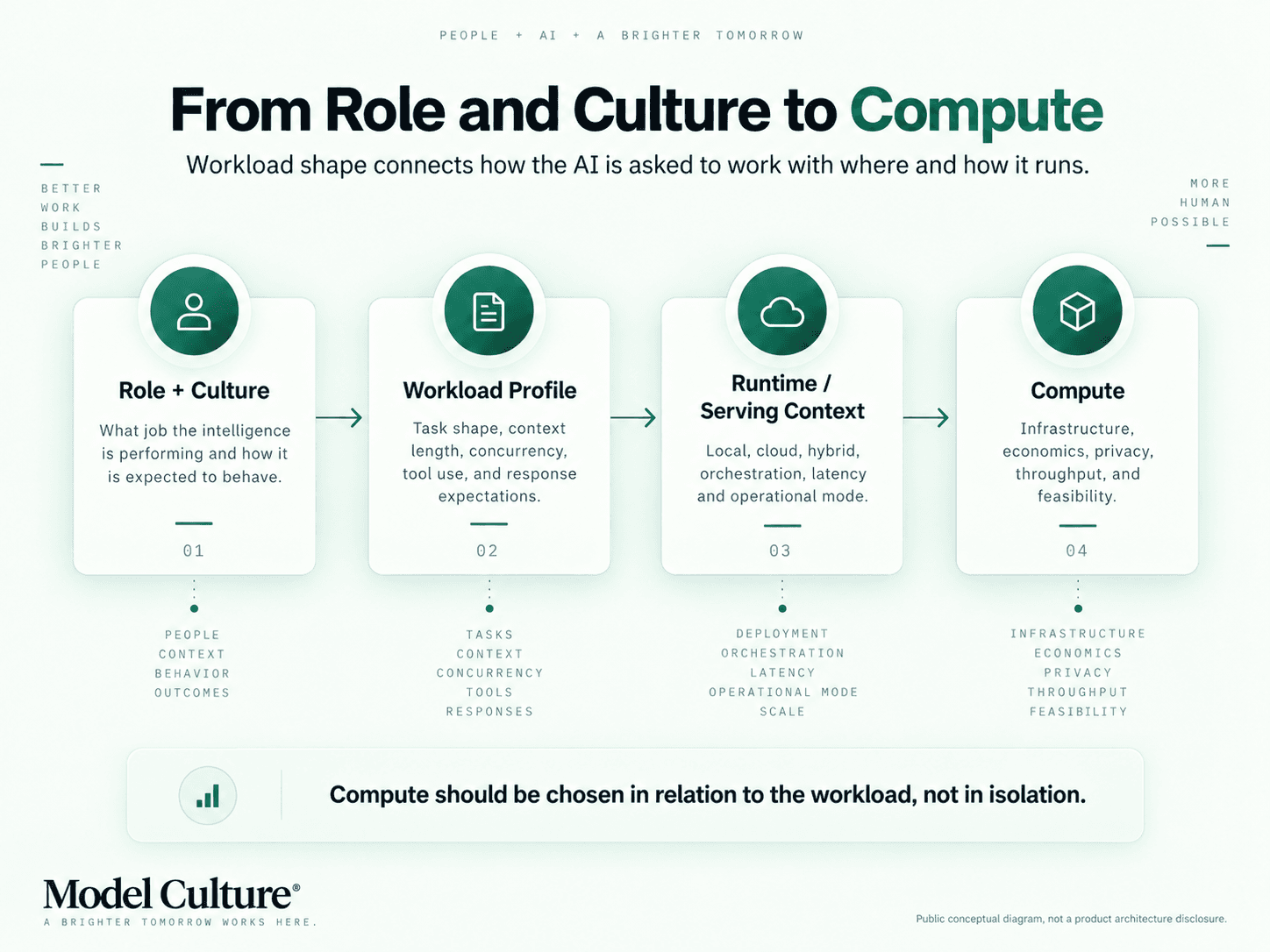
The decision
The configuration exists in relation to the work. The five factors describe that intelligence configuration. Work remains at the center.