
AI evaluation for real work

Which AI should do this job, here, for us?

Model Culture helps organizations evaluate exact intelligence configurations against real work, compare results under meaningful conditions, and preserve the evidence behind the decision. The answer is a configuration, not only a model family name.

Configuration

A model name is not a configuration

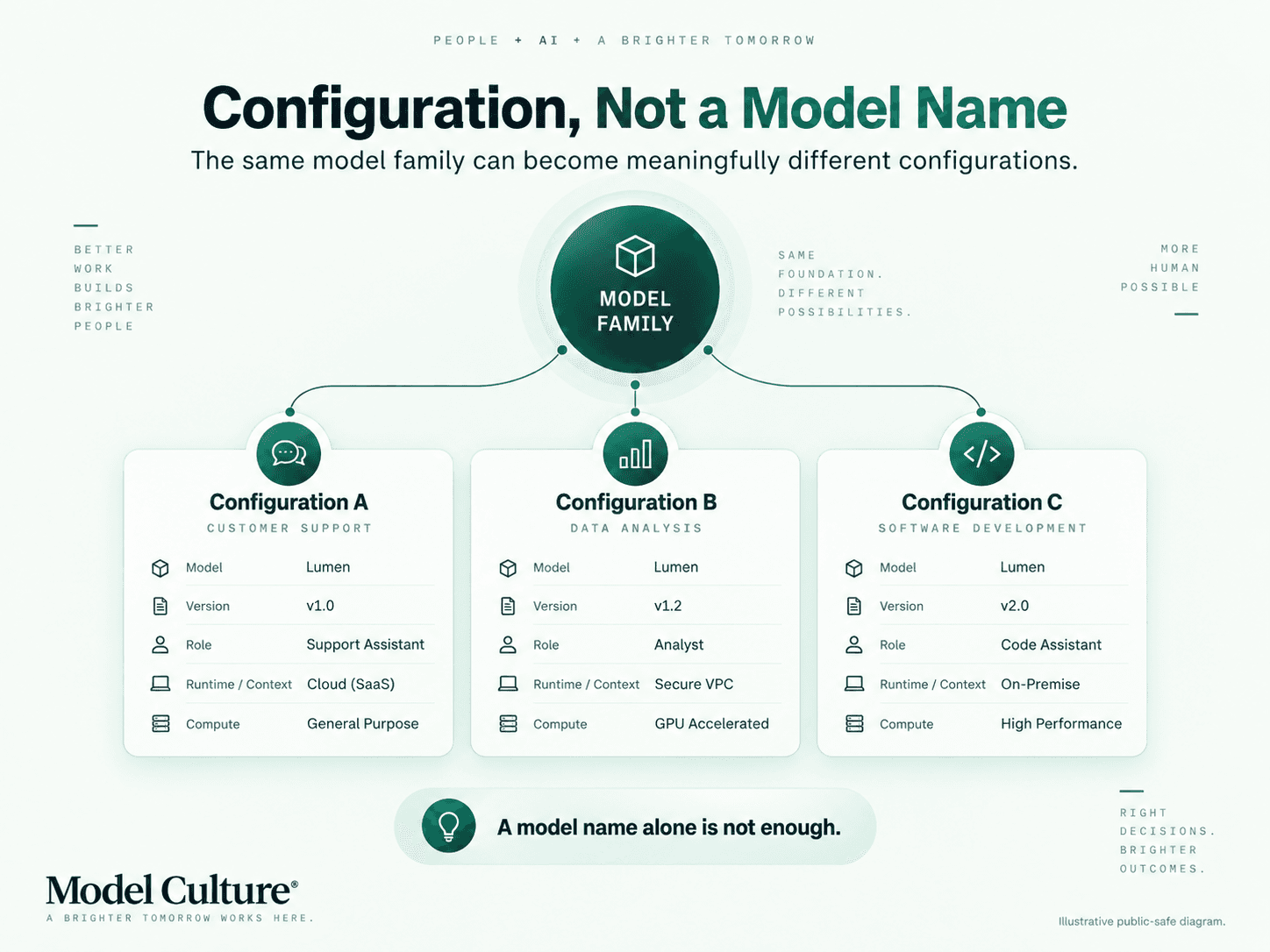
A model family is one part of what is being evaluated. The exact version, the role the AI is asked to perform, the surrounding runtime context, and the compute environment can materially change the configuration under review.

Those variables do not always change behavior, and they do not produce a universal ranking. They do mean that a family name alone is not enough to say what was actually evaluated.

Diagram showing one model family becoming three different intelligence configurations through version, role, runtime context, and compute.
The same model family can become meaningfully different configurations. Illustrative, and not a ranking of named systems.

Framework

Model Culture Core

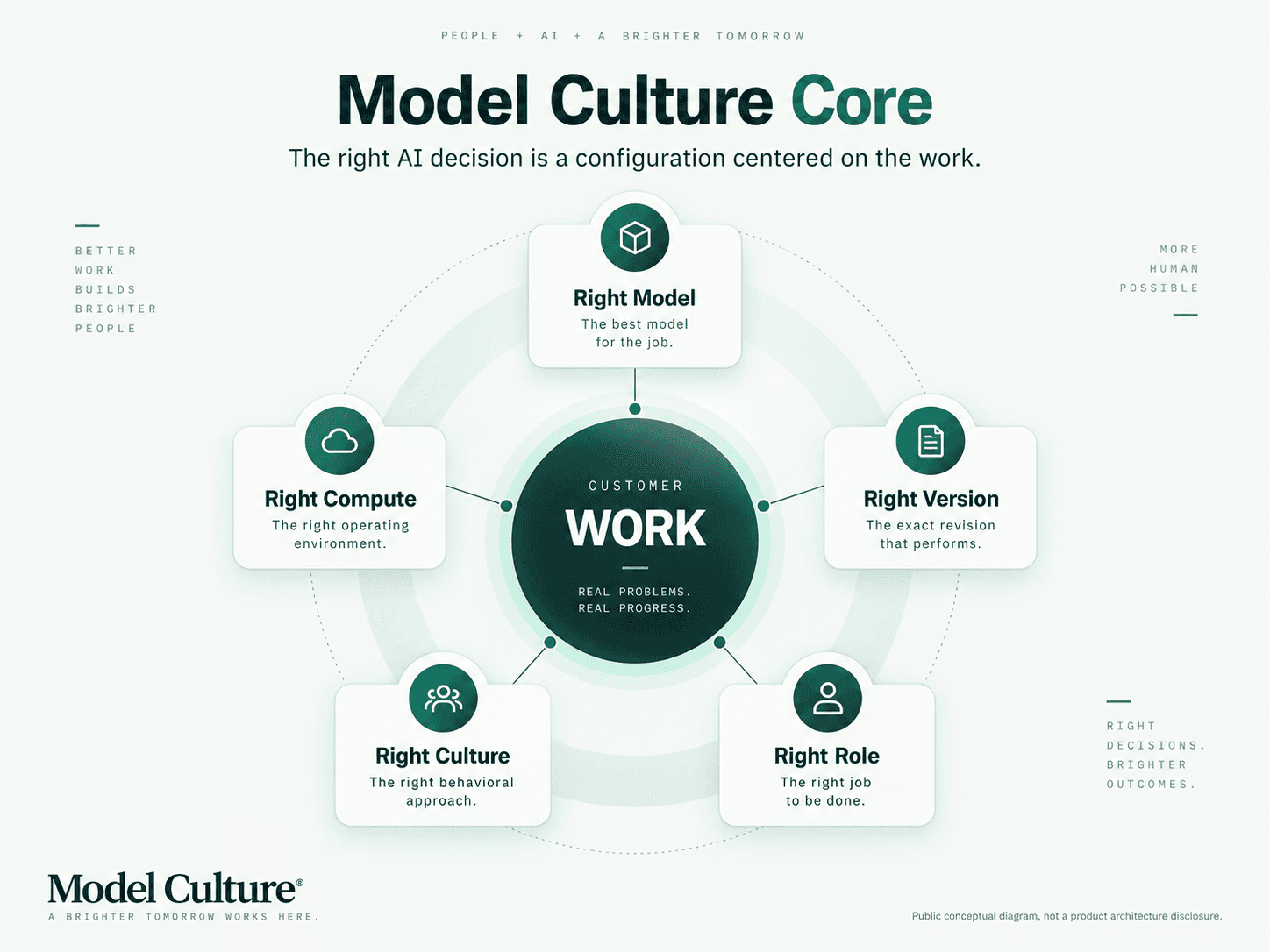
Customer work sits at the center. Around that work, the canonical framework is Right Model, Right Version, Right Role, Right Culture, and Right Compute. Work is the decision context, not a sixth pillar.

Model Culture Core diagram showing customer work at the center of Right Model, Right Version, Right Role, Right Culture, and Right Compute.
Customer work sits at the center of the five-factor configuration.

The answer is a configuration centered on the work.

  1. Right ModelThe model family suited to the work.
  2. Right VersionThe exact version, checkpoint, revision, or representation being evaluated.
  3. Right RoleThe job the AI is actually being asked to perform.
  4. Right CultureHow the AI behaves while performing that work, including evidence discipline, uncertainty handling, verification behavior, communication behavior, consistency, and similar role-relevant behavior.
  5. Right ComputeThe environment in which the intelligence actually operates, including cloud, hybrid, local, edge, infrastructure constraints, economics, privacy, latency, throughput, and feasibility.

Comparison

See a labeled comparison

This illustrative comparison shows how two intelligence configurations can be examined against the same defined workload. The workload is technical claim verification. The finding is descriptive: different configuration, different observed behavior.

Illustrative example

Not a universal model ranking and not a deployment recommendation.

Intelligence configuration

Configuration A

Model
Illustrative-7
Version
2026.03
Role
Technical claim reviewer
Runtime
Commercial API
Compute
Cloud
  • Evidence coverage

    Partial

    Some supporting material was cited; coverage of the claim was incomplete.

  • Consistency

    Variable

    Repeated trials produced different levels of caution.

  • Verification behavior

    Limited source checking

    The configuration often restated the claim without asking for missing evidence.

  • Latency

    Lower observed response time

    Observed under these conditions, not as a universal property.

  • Unresolved conditions

    Citation completeness remains open

    The record does not establish whether the configuration can complete source-backed verification.
Intelligence configuration

Configuration B

Model
Illustrative-7
Version
2026.06
Role
Technical claim reviewer
Runtime
Private VPC
Compute
Hybrid
  • Evidence coverage

    Broader cited support

    More of the supplied material was used when addressing the claim.

  • Consistency

    More stable across repeated trials

    Observed under these conditions, with a still-limited trial set.

  • Verification behavior

    More frequent requests for sources

    The configuration more often asked for missing evidence before accepting the claim.

  • Latency

    Higher observed response time

    Observed under these conditions, not as a universal property.

  • Unresolved conditions

    Peak-load throughput not established

    The record does not speak to behavior under a heavier operating load.

Different configuration. Different observed behavior.

Decision flow

How the decision moves

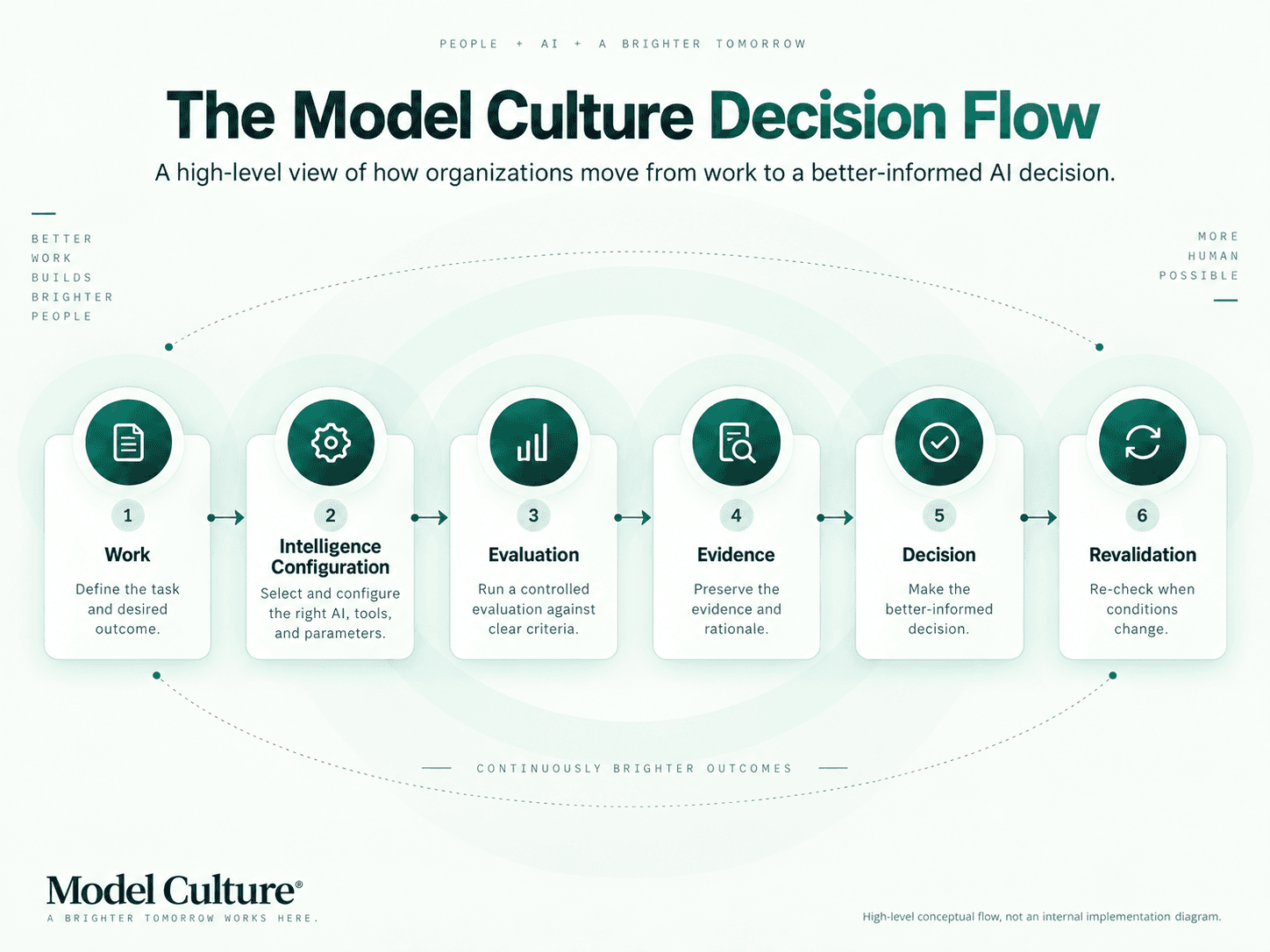
The sequence is work, intelligence configuration, evaluation, evidence, decision, and revalidation. It is a way to keep an AI decision inspectable as conditions change.

Diagram of the Model Culture decision flow from work through intelligence configuration, evaluation, evidence, and decision to revalidation.
A high-level view of how an organization can move from work to a better-informed AI decision.

Where it becomes useful

Model Culture matters when the AI decision has real consequences.

The framework becomes useful when an organization needs more than a model recommendation. It helps frame decisions where the work, the configuration, the operating conditions, and the evidence all matter.

  1. 01

    Choosing intelligence for a defined workload

    When multiple models or providers could perform the work, Model Culture keeps the comparison centered on the job, the conditions, and the intelligence configuration being evaluated.

  2. 02

    Evaluating change

    A new model, version, role, runtime, or operating condition can change what is actually being evaluated. Model Culture gives the organization a way to ask whether prior evidence still applies.

  3. 03

    Comparing deployment choices

    Cloud, private, local, sovereign, and hybrid environments introduce different constraints around privacy, latency, throughput, economics, and infrastructure. Those conditions belong inside the AI decision.

  4. 04

    Designing intelligence into a workflow

    The question is not only whether a model is capable. It is whether a particular intelligence configuration can perform the role the organization needs, under the conditions in which the work actually happens.

What the organization keeps

  • A decision grounded in the work

    The reason for selecting an intelligence configuration remains tied to the workload rather than only to vendor reputation or benchmark position.

  • A record of what was actually evaluated

    The organization retains the configuration identity, conditions, observations, provenance, and unresolved questions behind the decision.

  • A clearer reason to revalidate

    When something meaningful changes, the organization has a reference point for deciding whether previous understanding needs to be revisited.

  • Independent understanding

    Models and providers can change without requiring the organization to give up what it learned about the work.

Independence

Independent of the provider

Use the intelligence that fits the work. Keep your understanding independent of the provider. An organization may rent intelligence without renting its understanding of that intelligence.

Different workloads may call for different deployment and provider choices. The appropriate options depend on the work and operating constraints.

  • Commercial APIRented intelligence delivered through a provider interface.
  • Open weightA published model representation that can be evaluated as a specific version.
  • LocalIntelligence operating on infrastructure the organization controls.
  • PrivateA bounded environment with tighter access and data-handling constraints.
  • SovereignDeployment shaped by jurisdiction, residency, and control requirements.
  • CloudHosted operating environments used when they fit the work.
  • HybridA mix of environments chosen against workload and operating constraints.

Evidence

Evidence is what makes the decision inspectable

A useful evidence record preserves what was evaluated, the conditions around it, what was observed, and what remains unresolved. That record helps keep the decision inspectable as models, versions, providers, and operating conditions change.

Evidence record

Inspectable decision context

Illustrative exampleCompleted evaluation
Workload
Technical claim verification
Configuration identity
Illustrative-7 · 2026.06 · Technical claim reviewer · Private VPC · Hybrid
Conditions
Controlled comparison of two completed evaluations against the same workload description.
Observations
Configuration B showed broader cited support and more stable verification behavior in this example. Configuration A responded more quickly and left citation completeness unresolved.
Provenance
Organization-held illustrative record. First-party evaluation context. Not a third-party certification.
Unresolved questions
Citation completeness for Configuration A. Throughput under peak load for Configuration B.
Evaluation date
12 September 2026

Not an approved configuration and not a deployment recommendation.

Software

Model Culture Studio

Model Culture Studio is a working private R&D and evaluation application that operationalizes the Model Culture methodology. It provides a structured environment for defining work, evaluating intelligence configurations, comparing completed evaluations, and inspecting the evidence behind findings.

  • Structured evaluationDefine the work and the configuration being evaluated, then inspect what was observed.
  • ComparisonCompare completed evaluations under stated conditions, without collapsing the result into a universal winner.
  • Evidence inspectionKeep configuration identity, observations, and unresolved questions available for later review.

Research / Thinking

Serious questions about organizing intelligence

Model Culture is ongoing thinking about workload fit, version change, independent understanding, evidence, provenance, runtime context, compute economics, revalidation, and provider optionality. Research / Thinking tracks those questions as they develop.

Start with the work

Tell us the job, the constraints, and the decision.

If your organization is choosing intelligence for real work, begin with what the AI needs to do, what operating constraints matter, and what decision you are trying to make.